
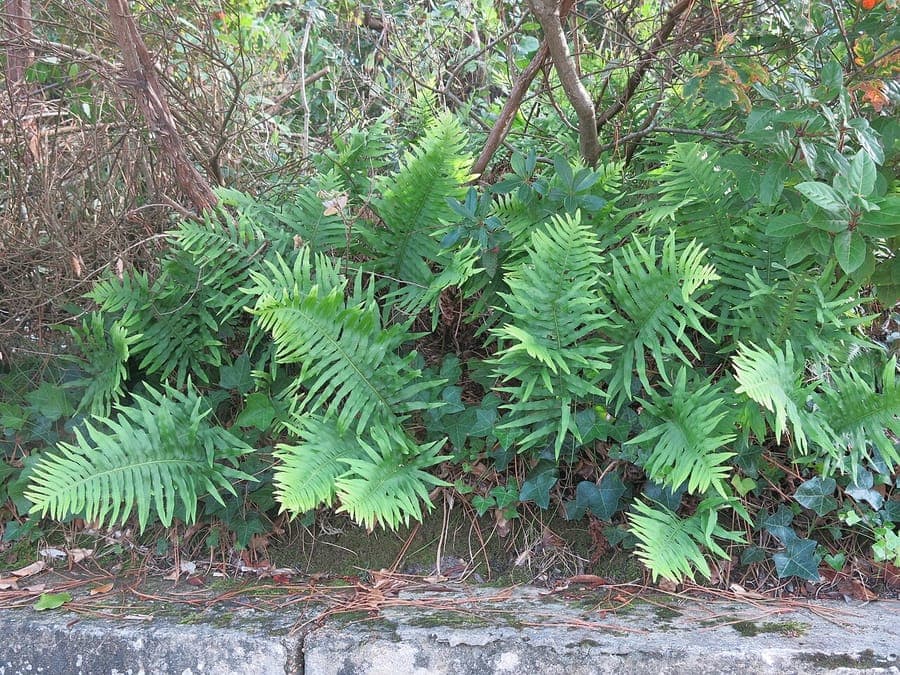
Tangopaso / Public domain, via Wikimedia Commons
Welsh polypody: complete guide
Polypodium cambricum
Mochten Sie Welsh polypody: complete guide in Ihrem Garten sehen?
1 Minute, keine Kreditkarte
Overview
The Welsh Polypody (Polypodium cambricum) is a small, elegant evergreen fern that thrives on rocky, shaded locations. This southern fern grows wild from Atlantic west to the Mediterranean, and is therefore more suited to sheltered locations in the Netherlands and Belgium.
The finest feature of this fern is the finely serrated foliage, which distinguishes it from related species. The plant is very long-lived and forms slowly expanding colonies. For gardeners seeking a subtle, refined shade fern, this is a perfect choice.
Appearance and Reproduction
The Welsh Polypody reaches a height of 15-30 centimeters. The leaves are very characteristic: doubly pinnate (twice divided), with very finely serrated edges on all leaflets. This gives the foliage a very delicate appearance.
The plant is evergreen, so foliage persists year-round. Young fronds are bright green and unfurl in spirals in spring. By summer the plant reaches full size. The underside of fronds bears sporangia (sori) that are brown colored.
Ideal Location
The Welsh Polypody is a fern for shaded, moist locations with good drainage. Rock walls, bases of wooded banks, caves with diffuse light - these are its natural habitats. Sea breeze and seawater can be problematic.
The plant grows best where three to four hours of indirect daylight are present. Southern European exposure requires some protection from intense midday sun. In northern regions more sun can be tolerated.
Soil
The Welsh Polypody prefers humus-rich, well-draining soil. Mixing sand and gravel with garden soil helps. Fern fertilizer is not needed. Regular leaf litter adds nutrition.
The pH may be neutral to slightly acidic. Excessively moist soil in winter is problematic. Alpine troughs and rock stackings work well.
Kostenloses Design
Mochten Sie Welsh polypody: complete guide in Ihrem Garten sehen? Erstellen Sie jetzt ein kostenloses Design.
Watering
The Welsh Polypody loves regular moisture during the growing season. The root zone should not dry out but should not become waterlogged. Summer mulching helps.
Maintenance
This fern requires minimal maintenance. Remove only diseased or damaged fronds. The plant grows slowly and does not form problematic vegetative masses.
Maintenance Calendar
Spring (March-May): Young fronds unfurl. Plant becomes active again after winter. Light feeding may help.
Summer (June-September): Growth continues. Fronds reach full size. Sporangia ripen. Regular moisture is essential.
Fall (September-November): Growth slows. Fronds remain green. Much leaf litter falls, providing humus.
Winter (December-February): Plant is largely dormant but fronds remain green. Very gentle maintenance needed.
Winter Hardiness
The Welsh Polypody is winter hardy to approximately 18°F (-8°C). This is usually sufficient for the Netherlands and Belgium, especially in sheltered locations. Colder winters may be problematic.
Companion Plants
Other evergreen ferns, Helleborus (Christmas rose), Epimedium (Fairy wings) and small Hedera (Ivy) form beautiful associations. Add contrast with Asplenium and Scolopendrium (Hart's tongue).
Closing Thoughts
The Welsh Polypody is indispensable for subtle, refined shadow corners. With minimal maintenance it thrives for years, elegant and modest. On gardenworld.app you will find more information.
Consult garden retailers for this precious fern. With the Welsh Polypody, you create a permanent, subtle shade beauty.
On gardenworld.app discover more about shade ferns and rock gardens.
Mochten Sie Welsh polypody: complete guide in Ihrem Garten sehen? Erstellen Sie jetzt ein kostenloses Design.
Foto hochladen, Stil wahlen und in unter einer Minute ein fotorealistisches Design inklusive Pflanzenliste erhalten.
Keine Kreditkarte erforderlich


Ähnliche Pflanzen
Dryopteris sieboldii: kompletter Ratgeber
Dryopteris sieboldii
Entdecken Sie Dryopteris sieboldii (Siebolds Schildfarn), ein eleganter immergruner Farn aus Asien. Anbau, Pflege und Garteneinsatz im Schatten.
Dryopteris tyrrhena: complete guide
Dryopteris tyrrhena
Discover Dryopteris tyrrhena (Mediterranean Buckler-fern), a rare and exquisite fern species. Growing tips, care, and shade garden design.
Dryopteris villarii: kompletter Ratgeber
Dryopteris villarii
Dryopteris villarii, auch als starrer Wurmfarn bekannt, ist ein schattenliebender Farn der Alpen. Entdecken Sie, wie Sie diesen eleganten alpinen Farn in Ihrem Garten anbauen und pflegen.