
Ed323 at English Wikipedia / Public domain, via Wikimedia Commons
Pohutukawa: complete guide
Metrosideros excelsa
Mochten Sie Pohutukawa: complete guide in Ihrem Garten sehen?
1 Minute, keine Kreditkarte
Overview
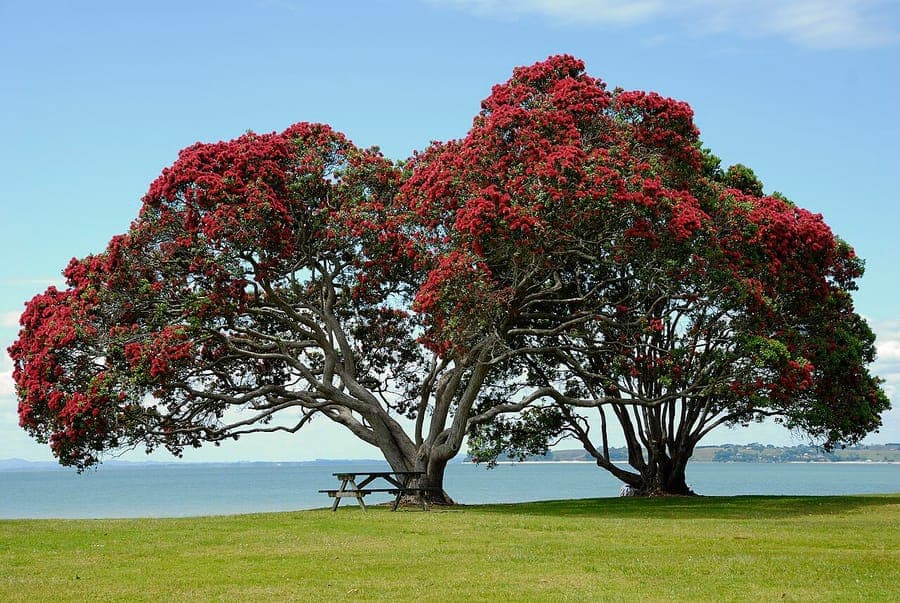
Metrosideros excelsa, better known as pohutukawa or New Zealand Christmastree, is a spectacular tree from the Myrtaceae family. This tree grows naturally in the northern part of New Zealand's North Island, where it dominates coastal areas. Pohutukawa has been introduced to various countries like the Azores, Madeira and Norfolk Islands, where it also thrives.
This tree is famous for its massive flowering period, when thousands of red flowers appear simultaneously, earning it the nickname "Christmas tree" in New Zealand (blooming in December). Pohutukawa can reach 20 to 30 meters in optimal conditions but remains much smaller in temperate climates. The tree is exceptionally tolerant of sea influences and succeeds in coastal areas where other trees struggle.
Appearance and Bloom
Pohutukawa grows as a broad, rounded tree with dense canopy. The leaves are thin, elliptical, dark green on the upper side and silvery on the underside. The bark is grayish-brown and becomes rough and interestingly fissured with age.
The flowers are the spectacular attraction: long, red staminal styles form large, brush-like clusters. These flowers typically appear November to December in the Southern Hemisphere, July to August in temperate northern climates. The blooming period lasts weeks. After flowering, woody fruits develop containing small seeds.
Ideal Location
Pohutukawa thrives best in full sun. At least six hours of direct sunlight daily is essential for strong growth and rich flowering. The tree tolerates strong sea winds excellently - this is one of its strongest points. Salt spray from the sea is no problem; pohutukawa grows even on rocks directly at the coast.
This tree is ideal for coastal landscapes and maritime settings. It can be used as a specimen tree but also grows well in groups. The tree is not suitable for sheltered urban areas without sufficient wind and light.
Soil
Pohutukawa is very flexible in soil preferences. It grows in poor, sandy, rocky soils but also thrives in more fertile grounds. The soil must drain well - this is more important than nutrient content. Waterlogging is fatal. pH can be neutral to slightly acidic.
In nutrient-poor soils the tree grows somewhat slower but ultimately equally strong. Don't add too much organic material when planting; this can be harmful rather than helpful. For container growing, use well-draining, somewhat sandy potting mix.
Kostenloses Design
Mochten Sie Pohutukawa: complete guide in Ihrem Garten sehen? Erstellen Sie jetzt ein kostenloses Design.
Watering
Once established, pohutukawa is very drought-tolerant. Young trees should be watered regularly until well-rooted, about once weekly during growing season. Older trees need much less water and can endure dry periods.
Seedlings in pots must be kept moister. Container trees need more frequent watering than ground-planted specimens. Don't allow water to pool - well-drained, somewhat dry soil is essential. In winter, established trees may need minimal watering.
Pruning
Pohutukawa naturally develops its own shape. Minimal pruning is usually needed. You can lightly prune flowering branches after bloom to stimulate more compact growth. This also encourages more branching.
Damaged or dead branches should be removed. The tree tolerates heavy pruning poorly - perform only light pruning. Don't cut back into old wood; the tree recovers poorly. Avoid drastic pruning.
Maintenance Calendar
Spring: Water young trees regularly, carefully plant out. Summer: Full growth, little intervention needed. Autumn: Flowering period builds up, preparation for bloom. Winter: Peak bloom, then reduce watering.
Winter Hardiness
Pohutukawa is not frost-hardy. It survives poorly below 5 degrees Celsius. In temperate climates of northern France, Great Britain and Scandinavia, it can only grow in sheltered microclimates or against warm south walls. Where frost threatens, better grow in containers and protect in winter.
In subtropical areas and the Mediterranean, pohutukawa grows without extra protection. In northern regions it is only winter-hardy in very mild, coastal locations.
Companion Plants
Pohutukawa grows well with other sea-wind tolerant plants. Combine with fatsia, pittosporum, escallonia and other maritime plants. Low settings with seagrass plants and sea thyme form nice underplantings. Large gravel and stones around the tree help drainage and reflect warmth.
From an aesthetic standpoint, pohutukawa works well as a backdrop for other plants, especially in contrast with blue or purple flowers.
Closing
Metrosideros excelsa is a spectacular tree for those with warmth and sea light. With its red flowers, sea-wind resistance and growth vigor, it is a classic for coastal gardens. In warm regions an essential tree; in temperate climates a challenge but achievable in ideal spots. For more garden inspiration consult gardenworld.app. Discover how this New Zealand treasure can transform your garden on gardenworld.app.
Mochten Sie Pohutukawa: complete guide in Ihrem Garten sehen? Erstellen Sie jetzt ein kostenloses Design.
Foto hochladen, Stil wahlen und in unter einer Minute ein fotorealistisches Design inklusive Pflanzenliste erhalten.
Keine Kreditkarte erforderlich


Ähnliche Pflanzen
Flooded gum (Eucalyptus grandis): kompletter Ratgeber
Eucalyptus grandis
Alles ueber den Flooded Gum: rasches Wachstum, beeindruckende Erscheinung und silbergraue Rinde. Pflanzung, Pflege und Standort im Garten.
Gelb-Eukalyptus (Eucalyptus leucoxylon): kompletter Ratgeber
Eucalyptus leucoxylon
Alles ueber den Gelb-Eukalyptus: winterliche Bluetenpracht, angenehmer Wuchs und Trockenheitstoleranz. Pflanzung und Pflege im Garten.
Sydney-Blaugummibaum (Eucalyptus saligna): kompletter Ratgeber
Eucalyptus saligna
Alles ueber den Sydney-Blaugummibaum: rasantes Wachstum, markante blaugraue Rinde und imposante Erscheinung. Standort, Pflege und Tipps.