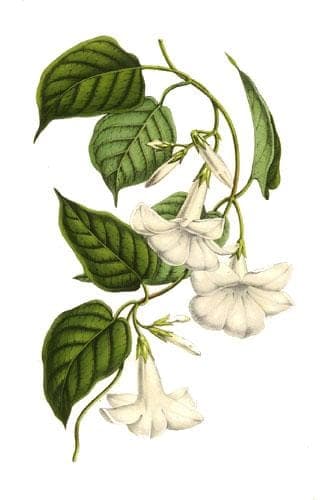
Wikimedia Commons / Public domain, via Wikimedia Commons
Chilean Jasmine: complete guide
Mandevilla laxa
Möchtest du Chilean Jasmine: complete guide in deinem Garten sehen?
Kompletter Entwurf in HD: 7,99 €
Chilean Jasmine pflegen mit der GardenWorld-App
Erkenne Pflanzen mit deiner Kamera und bekomme einen Pflegekalender mit Erinnerungen für diese Pflanze.


Overview
Mandevilla laxa, also known as Chilean Jasmine, is an elegant climbing plant from Peru and Bolivia with beautiful white fragrant flowers. This vine reaches heights of 3 to 5 meters and blooms abundantly from July to October with large white trumpet flowers that are intensely fragrant. It is a perfect choice for pergolas, walls, fences and warm sheltered locations where it can grow and reach its full potential.
Appearance and bloom
The plant has elongated, glossy green leaves that are alternately arranged. The stems grow lean upward or wind around support. The flowers are large, about 5 centimeters in diameter, pure white and have a trumpet-shaped structure. They appear in clusters at the stem tips and are very fragrant, especially in the evening. After flowering, long narrow seed pods form. The entire plant looks elegant and Mediterranean, typical of South American climbing plants.
Ideal location
This plant needs full sun for optimal blooming, at least 6 hours of direct sunlight daily. Plant it on the south side of a wall, against a warm facade or pergola. Protected spots are important because the plant is sensitive to strong wind gusts. The plant grows best against a warm wall or fence where it can fully develop. Avoid cold, damp locations or places with cold night wind gusts.
Soil
The soil must be well-draining and fertile. Add compost to regular garden soil. A mixture of garden soil, compost and sand in proportions 2:1:1 gives ideal conditions. The plant does better in fertile soils but also accepts poorer soil as long as it is well-draining. Avoid heavy clay soils that cause waterlogging. A mulch layer helps retain moisture near the roots.
Watering
Water regularly, especially during the growing and flowering season. Keep the soil moist but not waterlogged. Once established, the plant tolerates short droughts but performs better with consistently moist soil. Water deeper less frequently rather than shallow frequently. Water less in winter. Drip and soaker irrigation works better than overhead watering to prevent leaf disease. Regular checking of soil moisture is essential.
Gratis-Vorschau
Möchtest du Chilean Jasmine: complete guide in deinem Garten sehen? Erstelle eine gratis Vorschau deines Entwurfs.
Pruning
Mandevilla laxa responds well to pruning. Prune in early spring before new growth begins. Remove dead, damaged or diseased stems. Thin the plant to improve air circulation. After flowering, long climbing stems can be shortened for more compact forms. Annual pruning stimulates more side branches and thus more flowers. Pruning wounds exude sap and should be allowed to dry. Pruning during the growing season promotes branching and flowering.
Maintenance calendar
March-April: Pruning and preparing for growth. May-June: Support new growth, thinning where needed. July-October: Regular watering, enjoy flowering, remove spent flowers. November-February: Water less, light pruning, adjust maintenance conditions.
Winter hardiness
Mandevilla laxa is not hardy in frosty areas. In Northwest Europe it behaves as a tender plant. In frost-free zones it can overwinter. For frost-sensitive areas: dig out in autumn, store in cool greenhouse or replace each year. If you want to save the plant, minimal watering in winter helps. Thicker mulch around base in autumn gives some protection. Otherwise: treat as annual flowering plant to be replaced each season.
Companion plants
Mandevilla laxa can grow well with other climbers that share structural support simultaneously. Soft-growing hydrangeas, clematis and other delicate climbers can grow nearby. Underplanting with low-growing plants like ivy groundcover increases contrast. Avoid strong-growing climbers that could be displaced. Beautiful combination with roses or other flowers at the base. Combine with Mediterranean lavender or rosemary at the base.
Closing
Mandevilla laxa adds elegance, fragrance and tropical appearance to warm sheltered gardens. The white fragrant flowers and glossy green make it attractive year-round. At gardenworld.app you can design warm sheltered garden locations and select growth-supporting plant material. At gardenworld.app you find ideas for all heat zones and climbing plant combinations that grow together harmoniously.
Frequently asked questions about Chilean Jasmine
Is Chilean Jasmine winter hardy?
Mandevilla laxa is not hardy in frosty areas. In Northwest Europe it behaves as a tender plant.
When and how do you prune Chilean Jasmine?
Mandevilla laxa responds well to pruning. Prune in early spring before new growth begins.
How much water does Chilean Jasmine need?
Water regularly, especially during the growing and flowering season. Keep the soil moist but not waterlogged.
Where does Chilean Jasmine grow best?
This plant needs full sun for optimal blooming, at least 6 hours of direct sunlight daily. Plant it on the south side of a wall, against a warm facade or pergola.
What soil does Chilean Jasmine need?
The soil must be well-draining and fertile. Add compost to regular garden soil.

Sieh es in deinem Garten
Chilean Jasmine in deinem Garten
Ein Foto deines Gartens und ein paar Fragen. Nach etwa einer Minute siehst du das Ergebnis.
Mit einem Foto ausprobierenErkenne diese Pflanze in deinem eigenen Garten. Pflanze erkennen
Ähnliche Pflanzen
Röhrenstern: vollständiger Ratgeber
Amsonia hubrichtii
Alles über den Röhrenstern (Amsonia hubrichtii): Standort, Boden, Gießen, Rückschnitt und Winterhärte. Eine Präriestaude mit hellblauen Sternen und goldgelber Herbstfärbung.
Leuchterblume (Ceropegia woodii): Pflegeanleitung
Ceropegia woodii
Leuchterblume (Ceropegia woodii) pflegen: Licht, Gießen, Substrat, Vermehrung über Knöllchen, Überwinterung und ob die Herzchenkette für Katzen giftig ist.
Wachsblume (Hoya carnosa): der komplette Ratgeber
Hoya carnosa
Alles über die Wachsblume (Hoya carnosa): Licht, Gießen, Blütensporne, kühle Winterruhe, Stecklinge und Giftigkeit. Ungiftig für Katzen und Hunde.
