
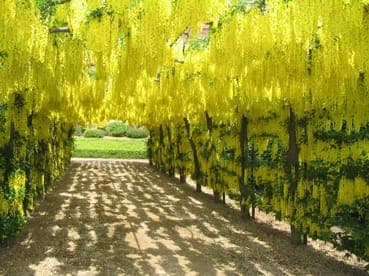
Keith Ramsden / CC BY-SA 2.0, via Wikimedia Commons
Laburnum watereri: complete guide
Laburnum watereri
Mochten Sie Laburnum watereri: complete guide in Ihrem Garten sehen?
1 Minute, keine Kreditkarte
Laburnum watereri, commonly known as Waterer's Laburnum or Golden Chain tree, is a spectacular decision-tree for any front yard or parkland landscape. This is actually a hybrid of two species (Laburnum anagyroides and Laburnum alpinum) and inherits the finest characteristics of both parents. The tree belongs to the Fabaceae family, the same as peas and beans.
Overview
Laburnum watereri is a medium to large tree typically reaching 5 to 8 meters in height. What makes this tree truly special are its long, pendulous flower chains appearing in May and June. The golden catkins can reach 30 to 40 centimeters in length, creating a spectacular display.
This tree is highly popular in European gardens and is often used as a specimen tree or as part of mixed borders. The golden flowers attract many bees and support pollinator populations in early summer. The visual impact of a mature specimen in full bloom is absolutely breathtaking.
Appearance and blooming
The leaves of Laburnum watereri are trifoliate, meaning they consist of three leaflets. They are green and fairly fine in texture. The tree has a naturally open, spreading growth habit that allows considerable light penetration.
Blooming occurs in May and June and is the highlight of the growing season. The long, pendulous chains of small, bright-yellow flowers are truly spectacular. Following blooming, elongated seed pods form and remain visible through autumn.
Important caution: all parts of this tree are toxic, especially the seeds. This must be kept in mind, particularly in gardens where children play.
Ideal location
Laburnum watereri performs best in sunny locations receiving at least 6 hours of direct sunlight daily. The tree can also grow in light dappled shade, but flowering will be somewhat less vigorous.
Choose a location with well-draining soil and protection from strong winds. The tree appreciates neutral to slightly acidic soil.
Soil requirements
Laburnum watereri is not fussy regarding soil conditions. It can grow well in many different soil types, from sandy to loamy soils. A pH of 6.0 to 7.5 is ideal.
The tree feels comfortable in well-drained soil and tolerates dry conditions exceptionally well. Add some organic matter when planting to improve soil structure, but this is not strictly necessary.
Kostenloses Design
Mochten Sie Laburnum watereri: complete guide in Ihrem Garten sehen? Erstellen Sie jetzt ein kostenloses Design.
Watering
When newly planted, Laburnum watereri needs regular water to establish a strong root system. During the first growing season, water regularly, especially during dry periods.
Once established, the tree tolerates drought very well. In fact, it prefers dry conditions, and excessive water can cause problems, especially in winter.
Pruning
Laburnum watereri requires minimal pruning. The tree grows naturally into an attractive form. You can remove dead wood after flowering (in July) and possibly do some shaping if desired. Avoid heavy pruning, as this can reduce flowering in subsequent years.
The tree recovers from pruning, but it is best to be cautious. Remove hanging branches carefully to ensure safety, especially over walking paths or seating areas.
Maintenance calendar
Spring (March-May): Monitor growth. Water regularly if dry. Remove dead branches.
Summer (June-August): Enjoy the spectacular blooms. Water rarely unless very dry. Prune after flowering.
Autumn (September-October): Monitor seed formation. Handle seeds carefully (toxic!).
Winter (November-February): Minimal care. Check for snow or ice damage.
Winter hardiness
Laburnum watereri is very hardy and tolerates temperatures down to -15 degrees Celsius. This is a true hardy tree for temperate climates. Young trees may benefit from protection in their first winters, especially in very harsh areas.
Companion plants
Laburnum watereri grows well alongside other spring-blooming trees and shrubs. Suitable companions include:
- Other spring bulbs and flowering plants
- Wisteria (for similar cascading effect)
- Berberis species
- Forsythia species
- Boxwood (Buxus) for hedging
Closing
Laburnum watereri is an absolute classic for gardeners seeking golden early-summer color. The spectacular long flower chains are truly enchanting. At gardenworld.app, we help you integrate this famous tree into your front yard design. With its effortlessly beautiful blooms and moderate growth rate, Laburnum watereri is a perfect choice for creating summer beauty and early-season interest.
Mochten Sie Laburnum watereri: complete guide in Ihrem Garten sehen? Erstellen Sie jetzt ein kostenloses Design.
Foto hochladen, Stil wahlen und in unter einer Minute ein fotorealistisches Design inklusive Pflanzenliste erhalten.
Schon 10.000+ Garten gestaltet
Keine Kreditkarte erforderlich


Ähnliche Pflanzen
Hohe Seidenlupine: kompletter Ratgeber
Lupinus elatus
Die hohe Seidenlupine ist eine schnellwachsende kalifornische Staude mit silbrigem Laub und blauvioletten Blütenähren, ideal für Präriegärten.
Garfield-Lupine: kompletter Ratgeber
Lupinus garfieldensis
Die Garfield-Lupine ist eine seltene, kraftvolle amerikanische Staude für kalkhaltige, trockene Präriegärten mit auffälligen blauen Blütenähren.
Lupinus elegans: kompletter Ratgeber
Lupinus elegans
Lupinus elegans, die elegante Lupine, ist eine spektakuläre Blütenpflanze aus Mexiko mit blauen Blütentrauben. Pflanzung und Pflanzenpflege.