
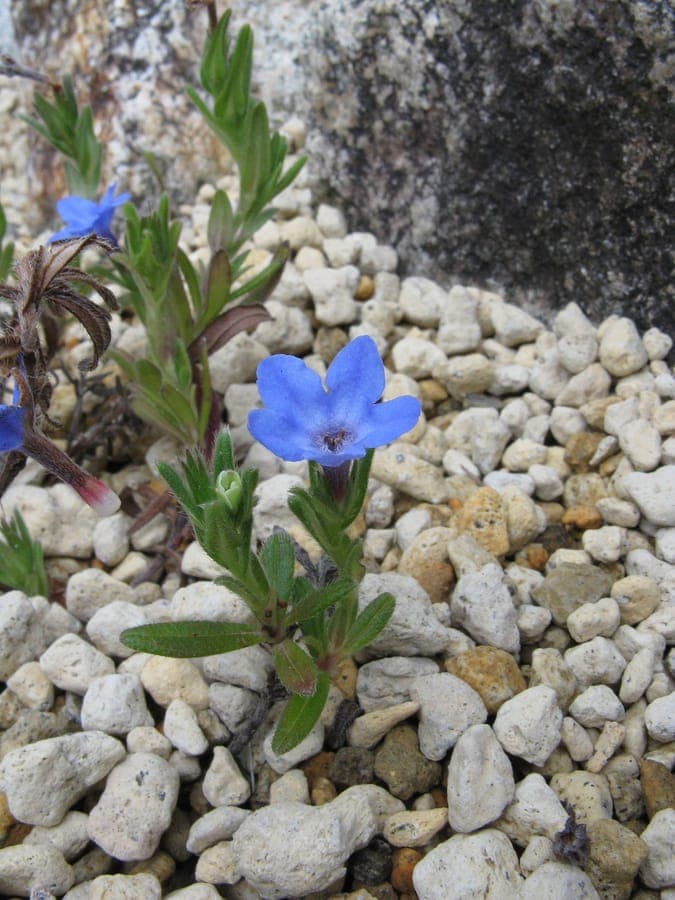
KENPEI / CC BY-SA 3.0, via Wikimedia Commons
Glandora diffusa: complete guide
Glandora diffusa
Mochten Sie Glandora diffusa: complete guide in Ihrem Garten sehen?
1 Minute, keine Kreditkarte
Overview
Glandora diffusa, also known as spreading gromwell or shrubby-gromwell, is a beautiful, low-growing plant originating from Spain. This member of the Boraginaceae family is a compact plant primarily used as a groundcover in rock gardens, alpine gardens, and Mediterranean planting schemes.
The plant forms dense patches of fine, tightly growing branches that usually reach only 20 to 40 centimeters high and can achieve much greater spread. The main attraction of Glandora diffusa is the numerous tiny, deep blue flowers that appear throughout virtually the entire growing season. The plant is extremely winter hardy, highly drought-tolerant, and virtually disease-free, making it an underrated choice for difficult spots in the garden.
Appearance and Bloom
The flowers of Glandora diffusa are small, about 0.5 to 1 centimeter in diameter, but extremely numerous. They are intense sky-blue to dark blue in color, sometimes with a light white center. Each flower has five round petals arranged in a disc or radial pattern. What truly makes this plant striking is that each flower appears perfectly symmetrical.
The leaves are small, linear to lanceolate, about 0.5 to 2 centimeters long, and very densely placed on the stems. The leaf color is typically gray-green to blue-green, which complements the blue flowers beautifully. The plant naturally forms dense, grasshopper-like growth that itself functions as a groundcover.
Blooming period extends from April through October, with peak flowering in May, June, and September. In warm climates, blooming may be briefly interrupted during very hot periods in July and August, but resumes once temperatures cool somewhat.
Ideal Location
Glandora diffusa grows optimally in full sun to light partial shade. The plant feels at home on warm, dry locations with full sunlight. In very warm, Mediterranean climates, light afternoon shade can actually prevent flowers from withering.
The location must absolutely drain well. This is the critical factor for success with this plant. Plant on slopes, in raised beds, or in rock gardens where water cannot stagnate. The plant does not tolerate heavy, wet soil conditions.
Good air circulation is also important. Avoid dense, humid pockets in the garden where fungal diseases can thrive. The location can be windy without negative effects.
Soil
Glandora diffusa is not demanding regarding soil, as long as it drains well. The plant can grow in poor, sandy, rocky terrain with minimal nutrition. In nature, it grows in Spanish mountain terrain often on very lean, stony soils.
For best results, create a very well-draining soil mix of sand, gravel, and some potting soil. Many growers use nearly pure mineral mixes such as sand with gravel. Add some organic material (about 20 to 30%) for some moisture retention, but most of the mix should be mineral.
PH can vary from neutral to slightly acidic (pH 6.0 to 7.5). This plant is not very pH-sensitive and grows well in most soils.
Kostenloses Design
Mochten Sie Glandora diffusa: complete guide in Ihrem Garten sehen? Erstellen Sie jetzt ein kostenloses Design.
Watering
Watering needs of Glandora diffusa are very low. Once established, this plant is extremely drought-tolerant and can survive long periods without water. Even young plants, once properly rooted, require relatively little watering.
During the growth and blooming period (spring through fall), water regularly but allow the soil to dry completely between waterings. The soil should actually be drier rather than wet. In summer, with regular heat, even some short dry periods can be beneficial for stimulating more flowers.
In winter, especially in humid climates, virtually no watering is needed. Only water if it has been very long without rain and you are worried about extreme drought.
Pruning
Glandora diffusa requires minimal pruning because it naturally remains compact and neat. In spring, one can lightly prune about one-quarter of old growth to keep the plant more compact and stimulate new foliage.
Wilted flowers: these can be removed, but since the plant produces endless flowers, it is not really necessary. In fact, by not pruning, you create a more maintenance-free plant.
Old, long branches growing outside the pattern can be cut back to more compact side branches. However, excessive pruning can damage the plant - less is more here.
Maintenance Calendar
Spring (March-May): Light pruning of old growth. Water regularly as new growth appears. No feeding needed, but weak feeding in very poor soils can help. Monitor for insects (usually not a problem).
Summer (June-August): Minimal watering, only if extremely dry. Watch for extreme heat in very warm regions that may reduce blooming. No feeding.
Autumn (September-October): Blooming may revive as temperatures cool. Water minimally only after dry periods.
Winter (November-February): No watering unless very long without rain. Protect against excessive wet conditions in very wet climates with drainage improvements.
Winter Hardiness
Glandora diffusa is extremely winter hardy. This plant can withstand temperatures to -15 to -20 degrees Celsius and grows in mountainous areas in Spain at elevations up to 2000 meters. In most European climates, this plant is reliably hardy.
The main threat to overwintering is not frost, but wet growing conditions. The plant can suffer from wet feet in winter. Therefore, ensure exceptionally well-draining growing conditions.
In very warm Mediterranean climates where winter nights are mild, the plant grows as if it were summer.
Companion Plants
Glandora diffusa combines beautifully with other Mediterranean, drought-tolerant plants:
- Aubrieta (Aubrietia species)
- Phlox subulata (creeping phlox)
- Helianthemum species (rock rose)
- Dianthus species (pinks)
- Saxifraga species
- Small Sedum species
- Alchemilla alpina
- Veronica species
These combinations form attractive, low-maintenance alpine plantings.
Closing Remarks
Glandora diffusa is a valuable underpinning for difficult, dry garden corners. With its exquisite blue flowers, extremely low maintenance requirements, and exceptional winter hardiness, it is a plant that many gardeners could benefit from. Whether you are building a rock garden or simply want something that grows with zero care, this Spanish groundcover would be worth considering. Check with specialized alpine nurseries for available plants, or consult Gardenworld.app for help integrating Mediterranean plants into your design. With good drainage management and minimal maintenance, you will enjoy decades of this beautiful plant.
Mochten Sie Glandora diffusa: complete guide in Ihrem Garten sehen? Erstellen Sie jetzt ein kostenloses Design.
Foto hochladen, Stil wahlen und in unter einer Minute ein fotorealistisches Design inklusive Pflanzenliste erhalten.
Schon 10.000+ Garten gestaltet
Keine Kreditkarte erforderlich


Ähnliche Pflanzen
Westliches Wasserblatt: kompletter Ratgeber
Hydrophyllum occidentale
Alles ueber das westliche Wasserblatt (Hydrophyllum occidentale): Standort, Boden, Giessen, Winterhaerte und Verwendung im naturnahen Schattengarten.
Kalkstein-Phacelie (Phacelia affinis): kompletter Ratgeber
Phacelia affinis
Alles uber Phacelia affinis, die Kalkstein-Phacelie: Aussaat, violett-blaue Bienenbluten, Trockenheitstoleranz und Einsatz im naturnahen Vorgarten.
Pyrenaen-Natternkopf: kompletter Ratgeber
Echium asperrimum
Echium asperrimum ist eine beeindruckende Zweijahrige aus dem Westmittelmeerraum mit rauen Borsten-Stangeln und leuchtend blauen Bluten. Ideal fur trockene Staudenbeete.