
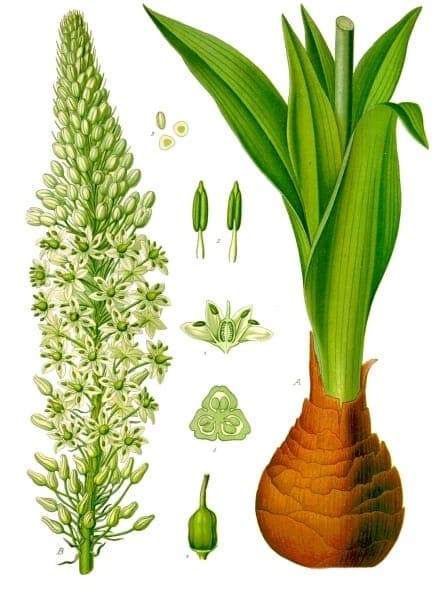
Franz Eugen Köhler, Köhler's Medizinal-Pflanzen / Public domain, via Wikimedia Commons
Red-squill: complete guide
Drimia maritima
Mochten Sie Red-squill: complete guide in Ihrem Garten sehen?
1 Minute, keine Kreditkarte
Overview
Red-squill (Drimia maritima), formerly known as Scilla maritima or Urginea maritima, is a remarkable Mediterranean bulb from the Iberian Peninsula and North Africa. This unusual member of the Asparagaceae family impresses with its large, silver-green glossy foliage and white or pink-tinged flowers in loosely spaced panicles. Red-squill is a winter-growing plant from Mediterranean climates - its foliage appears in autumn and winter, and it flowers in summer. This reversed growth rhythm makes it a singular addition to Mediterranean gardens, dry-soil situations, and botanical collections. On gardenworld.app, you can design gardens where this historically fascinating plant plays a special role.
Appearance and bloom
Red-squill grows from a massive underground bulb (up to 15 centimetres in diameter) whose bulky, silver-green glossy leaves appear from October to April. These leaves are lance-shaped to trumpet-like and reach 30-60 centimetres length, giving the plant a decidedly distinctive presence. In summer (June-August), when the foliage yellows, a stout flower stem emerges (up to 150 centimetres tall!) bearing hundreds of tiny white or pale pink flowers in loosely pyramidal panicles. Each flower measures roughly 5-8 millimetres across. The plant emits a strong, sweet fragrance intensifying in evening hours. After flowering, small seeds develop in capsules.
Ideal location
Red-squill demands full sun - at least eight hours of direct sunlight daily. The plant thrives in warm, dry, well-drained sites. A south- or west-facing position against a wall is ideal. In Mediterranean gardens, it succeeds on dry slopes amongst other Mediterranean shrubs. Also suitable for dry rock gardens and alpine troughs on a very warm site. In temperate climates, container cultivation in a warm greenhouse or on a very sheltered, warm patio corner is recommended.
Soil requirements
Red-squill accepts virtually any well-draining soil but performs best on poor, sandy to gravelly ground. In heavy clay, improve with coarse sand, gravel, and compost. The plant thrives on Southern European, lime-rich soils. For container cultivation use a special mix: standard compost, coarse sand, and gravel in a 40/40/20 ratio. Good drainage is essential.
Kostenloses Design
Mochten Sie Red-squill: complete guide in Ihrem Garten sehen? Erstellen Sie jetzt ein kostenloses Design.
Watering
Red-squill is extremely drought-tolerant and requires minimal water. During the growing season (October-April), water only when the soil becomes very dry. During summer dormancy (May-September), virtually no water is needed - the plant enters hibernation. Container plants follow the same regime. Overwatering is the primary cause of failure with this plant.
Pruning
Red-squill requires no pruning. Remove dead foliage in June-July as the leaves yellow and die back. This is natural and healthy. After flowering, you may remove spent flower stems.
Maintenance calendar
October-November: First foliage growth appears. Water very lightly.
December-March: Complete foliage growth. Plant builds reserves in the bulb.
April: Foliage begins yellowing. Gradually reduce watering.
May-August: Flower stem emerges and blooms. Plant in full sun. No water. Flower stem may need support.
September: Plant enters dormancy. Keep dry. For container plants: place in warm, dry location.
Winter hardiness
Red-squill is hardy to approximately -5°C in southern temperate regions on sheltered sites. In northern regions, container cultivation under glass (minimum 5-10°C) is recommended. The plant overwinters without difficulty under glass. Outdoor cultivation in northern Europe succeeds only in very warm, sheltered situations with artificial winter protection.
Companion plants
Red-squill combines nicely with other Mediterranean drought-lovers such as Euphorbia, Agave, Aloe, and Sedum in container combinations. In Mediterranean gardens, pair with Lavandula, Rosmarinus, Cistus, and other shrubs. The winter foliage of red-squill provides interest when many other plants are dormant. In container groupings, combine with other exotic, drought-tolerant bulbs and succulents.
Toxicity
Warning: Red-squill contains toxic glucosides (cardiac glycosides) and is traditionally used as a pesticide in Mediterranean countries. All plant parts are poisonous if ingested. Ensure children and pets do not touch the plant. Wash hands after handling.
Conclusion
Red-squill is an exceptional plant for gardeners with dry, sunny sites and a passion for historically fascinating Mediterranean flora. The massive bulb, unique winter foliage, and majestic summer flower stem make this plant unforgettable. Red-squill supports gardenworld.app's vision of diverse garden solutions for challenging, dry sites. Plant red-squill this autumn and discover the mystical allure of this ancient Mediterranean resident.
Mochten Sie Red-squill: complete guide in Ihrem Garten sehen? Erstellen Sie jetzt ein kostenloses Design.
Foto hochladen, Stil wahlen und in unter einer Minute ein fotorealistisches Design inklusive Pflanzenliste erhalten.
Keine Kreditkarte erforderlich


Ähnliche Pflanzen
Sizilianischer Honiglauch: kompletter Ratgeber
Allium siculum
Sizilianischer Honiglauch (Allium siculum) ist eine elegante mediterrane Zwiebel mit hängenden roten Blüten. Winterhart bis USDA Zone 5. Blüht Mai bis Juni mit charakteristischen hängenden Doldendolden.
Sibirische Sternhyazinthe: kompletter Ratgeber
Scilla siberica
Entdecken Sie die Scilla siberica, die zuverlassigste und produktivste Fruhlingszwiebel. Mit lebhaften blauen Bluten, die sich naturlich vermehren, schafft sie atemberaubende naturalisierte Massen.
Ornithogalum arabicum: kompletter Ratgeber
Ornithogalum arabicum
Entdecken Sie die Arabische Milchstern: eine mediterranen Zwiebelpflanze mit weißen Sternblüten. Ideal für Frühjahrsbeete und Mittelmeersgärten.