
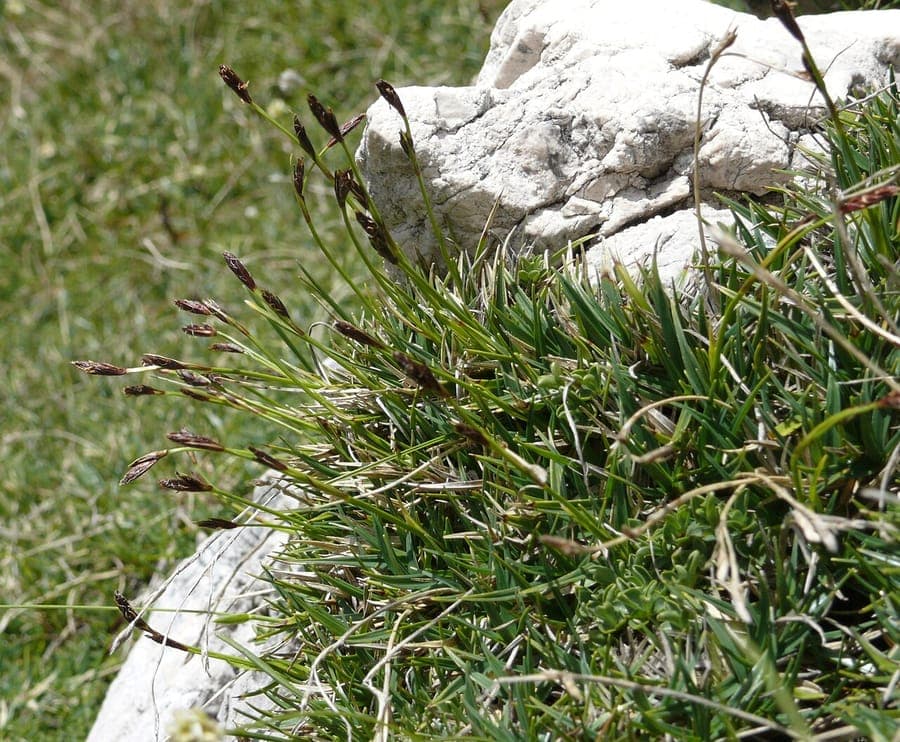
Bernd Haynold / CC BY 2.5, via Wikimedia Commons
Carex firma: complete gids
Carex firma
Mochten Sie Carex firma: complete gids in Ihrem Garten sehen?
1 Minute, keine Kreditkarte
Overview
Carex firma, better known by its German name Polster-Segge (cushion sedge), is an extremely compact sedge species from European mountain regions. This low-growing plant thrives in its natural habitat on rocky mountain slopes and alpine meadows between 800 to 2600 meters elevation in Austria, Switzerland, France, Italy, and Germany. With its densely growing, cushion-shaped growth habit, it's ideal as a groundcover in alpine gardens and mountain borders. The plant provides blue-green foliage year-round.
Appearance and bloom
Carex firma reaches only 5 to 15 cm height and spreads slowly to approximately 20 to 30 cm width. The leaves are fine, narrow grass sedges forming a dense, green cushion. The flowers are inconspicuous brownish, small, and without great visual appeal. The blooming period runs from May to June. The plant is prized primarily for its compact growth and blue-green foliage.
Ideal location
Carex firma grows best in full sun to partial shade. The plant flourishes better with at least four hours of direct sunshine daily. Even in some shade the plant can grow, though growth becomes more compact and foliage slightly darker.
Soil
This plant requires well-drained, slightly acidic mountain soil (pH 5.0 to 5.5). Heavy clay soils must be improved with gravel and sand. The plant thrives on nutrient-poor mountain soils and tolerates nutrient-rich garden soil less well.
Kostenloses Design
Mochten Sie Carex firma: complete gids in Ihrem Garten sehen? Erstellen Sie jetzt ein kostenloses Design.
Watering
Once established, Carex firma has moderate moisture needs. Water regularly during growth period but never waterlogged. The plant tolerates some drought better than waterlogging. Summer: adjust water for dry spells. Winter: minimal water.
Pruning
Practically no pruning needed. In spring remove dead material from the previous year. The plant grows slowly and naturally maintains a neat, compact form.
Maintenance calendar
Spring (March-April): remove dead material, new growth appears. May-June: blooming, no maintenance needed. Summer: maintain moderate moisture. Autumn: prepare for winter rest. Winter: minimal maintenance.
Winter hardiness
Carex firma is extremely hardy and tolerates temperatures to -30 degrees Celsius. The plant remains evergreen and provides year-round green color. Suitable for USDA zones 2 to 8. Much better suited to cold climates than warm.
Companion plants
Carex firma forms a perfect groundcover around dwarf conifers and mountain plants. Also lovely beside saxifrages, primula, and other compact alpine plants. Ideal for alpine troughs and meadows.
Closing
Carex firma is an inconspicuous yet essential plant for alpine gardens. With its compact growth, year-round green appearance, and minimal maintenance needs, it fulfills an important role as groundcover. The plant is reliable and provides fresh growth annually. Available through specialized nurseries. Gardenworld.app provides design support for mountain gardens and alpine collections.
Mochten Sie Carex firma: complete gids in Ihrem Garten sehen? Erstellen Sie jetzt ein kostenloses Design.
Foto hochladen, Stil wahlen und in unter einer Minute ein fotorealistisches Design inklusive Pflanzenliste erhalten.
Keine Kreditkarte erforderlich


Ähnliche Pflanzen
Flachhalm-Strandsimse: kompletter Ratgeber
Bolboschoenus planiculmis
Alles zur Flachhalm-Strandsimse (Bolboschoenus planiculmis): Standort, Boden, Wasserbedarf, Pflege und Verwendung am Teichrand.
Bush-Zypergras: kompletter Ratgeber
Cyperus lupulinus
Alles ueber das Bush-Zypergras (Cyperus lupulinus): Standort, Boden, Pflege und Garteneinsatz. Praxistipps fuer Teichraender und sandige Gartenboeden.
Goldgelbes Schnabelried: kompletter Ratgeber
Rhynchospora corymbosa
Alles ueber das goldgelbe Schnabelried (Rhynchospora corymbosa): eine tropische Uferstaude mit spektakulaeren Goldsternen fuer Teiche und Moorbeete.