
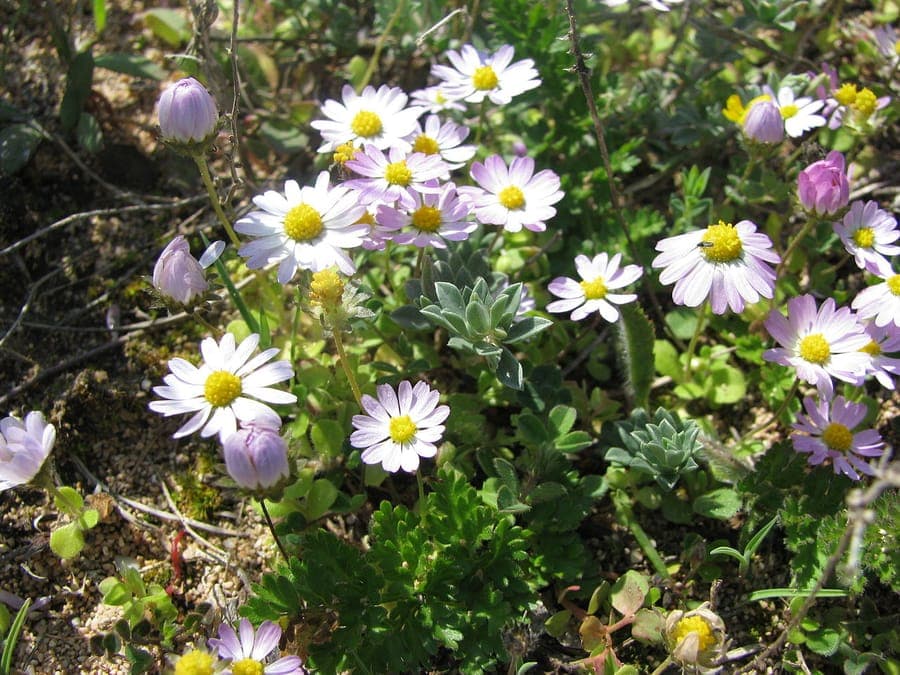
No machine-readable author provided. Hagen Graebner assumed (based on copyright claims). / CC BY 3.0, via Wikimedia Commons
Bellis annua: complete guide
Bellis annua
Mochten Sie Bellis annua: complete guide in Ihrem Garten sehen?
1 Minute, keine Kreditkarte
Overview
Bellis annua, known as annual daisy or annual daisy, is a delicate flowering plant from the Mediterranean region. This compact annual is renowned for its countless tiny white to pink flowers resembling miniature chrysanthemums. In temperate gardens, Bellis annua flowers from April through October and adds a fresh, cheerful element.
The plant is ideal for borders, flower boxes, rock gardens, and as underplanting. It grows compactly, about 15 to 30 centimeters tall, and flowers continuously with minimal care. Bellis annua is one of the most low-maintenance garden flowers.
Appearance and flowering
Bellis annua forms compact, bushy plants with fine, linear leaves. The plant has no showy foliage but is devoted entirely to flowering. The flowers are small daisy heads with white to pink ray florets surrounding a yellow center. Blooms measure about 1 to 2 centimeters across.
Flowering is extremely continuous. From April (or May after last frost) through October, these plants flower relentlessly. Even after frost, they quickly recover and continue blooming. This makes Bellis annua exceptionally valuable in gardens.
Various cultivars exist, from pure white to deep pink. Some are fringed or double.
Ideal location
Bellis annua grows best in sunny to partly shaded spots. Minimum 4 to 5 hours of direct sunlight daily is needed. More sun produces more flowers. The plant tolerates some shade but becomes thinner.
In very hot, dry conditions, afternoon shade helps. Heavy south-facing wall heat can be problematic in very dry summers.
The plant is not fussy. It even grows in partial shade under trees, though flowering is then less abundant.
Soil
Bellis annua thrives in virtually all soil types, from poor to fertile. The plant has no special requirements and flourishes even in somewhat poor soils. This makes it ideal for marginal garden spots.
Some well-structured, well-draining soil helps. Add sand to very compact clay. pH can be neutral to slightly acidic.
The plant tolerates some salt spray and even grows near the coast.
Watering
Bellis annua has moderate water needs. Water when the top centimeter of soil feels dry, usually 1 to 2 times weekly in normal summers.
In very dry periods, water more. Mulch can help retain moisture.
Once well-rooted, Bellis annua tolerates some drought. This makes it a beneficial plant for water-conscious gardens.
Don't overwater as this can lead to leaf mildew.
Kostenloses Design
Mochten Sie Bellis annua: complete guide in Ihrem Garten sehen? Erstellen Sie jetzt ein kostenloses Design.
Feeding
Bellis annua doesn't need much fertilizer. Light, regular feeding can help significantly extend blooming. Once monthly light garden fertilizer during the growing season is sufficient.
Alternatively: Add organic matter at planting and no further feeding is needed.
Overfeeding leads to more foliage and less blooming. Avoid nitrogen-rich fertilizers.
Sowing and propagation
Bellis annua is grown from seed. Seeds need light to germinate, so don't cover. Sow in February-March in seed trays on a windowsill.
Ideal germination temperature: 15 to 20 degrees Celsius. Germination time: 10 to 14 days.
Prick out seedlings when they have 2 to 3 leaf pairs and harden off. Plant outdoors after last frost.
Alternatively: Direct sow outdoors in April-May.
Maintenance
Regularly removing spent flowers (deadheading) enormously stimulates continuous blooming. Pinch back long stems to maintain compact form.
The plant is practically pest-free. In humid conditions, monitor for powdery mildew; prevent with good air circulation.
By late October, flowering declines and the plant dies. This is normal for annuals.
Companion plants
Bellis annua combines well with:
- Ornamental onions (Ornithogalum) for vertical accent
- Blue forget-me-nots for color contrast
- Violas and pansies in complementary colors
- Silene (catchfly) for texture
- Ivy-leaved geraniums trailing around
Layering combinations:
- Lavender behind
- Thyme to the side
- Pink verbena as filler
Container growing
Bellis annua flowers beautifully in flower boxes and hanging baskets. Plant 5 to 7 plants per 30cm container. Use well-draining potting soil. Ensure drainage holes.
In containers, more water needed than in ground. Check daily in hot summers. Feed every two weeks.
Closing remarks
Bellis annua is an essential flower for temperate gardens. With minimal care, simple requirements, and continuous blooming, this plant deserves a place. Plant in April-May and enjoy months of floral abundance. Visit garden centers for seeds or grown plants. Gardenworld.app helps you plan combinations. This simple, charming flower brings joy all summer and autumn.
Mochten Sie Bellis annua: complete guide in Ihrem Garten sehen? Erstellen Sie jetzt ein kostenloses Design.
Foto hochladen, Stil wahlen und in unter einer Minute ein fotorealistisches Design inklusive Pflanzenliste erhalten.
Keine Kreditkarte erforderlich


Ähnliche Pflanzen
Calendula stellata: kompletter Ratgeber
Calendula stellata
Kompletter Ratgeber zur Stern-Ringelblume Calendula stellata: Standort, Boden, Giessen und passende Begleitpflanzen im Garten.
Koreanische Garten-Chrysantheme: kompletter Ratgeber
Chrysanthemum x rubellum
Chrysanthemum x rubellum ist eine winterharte Herbststaude mit einfachen rosa bis kupferfarbenen Blueten von August bis November.
Helianthus divaricatus: kompletter Ratgeber
Helianthus divaricatus
Helianthus divaricatus ist eine nordamerikanische Waldsonnenblume mit gelben Sommerblueten, ideal fuer naturnahe Rabatten und Waldraender.