
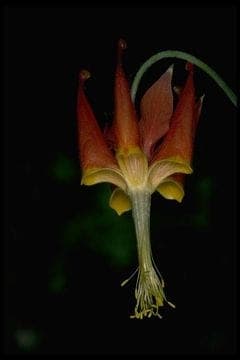
John Game / CC BY-SA 4.0, via Wikimedia Commons
Aquilegia eximia: complete guide
Aquilegia eximia
Mochten Sie Aquilegia eximia: complete guide in Ihrem Garten sehen?
1 Minute, keine Kreditkarte
Overview
Aquilegia eximia, commonly called Van Houtte's columbine, is a distinctive and rare flower native to Western California. This unique species is known for its striking red spurs and yellow flowers, a combination more elegant than its close relatives.
The plant belongs to the Ranunculaceae family and is a classic favorite of botanical garden lovers seeking rarities. Aquilegia eximia is, for its rarity and distinctive characteristics, a true gem for the front yard.
This species is not easy to find in commercial nurseries, but for those who can obtain it, it delivers an unforgettable flowering experience.
Appearance and bloom period
Aquilegia eximia forms a compact plant approximately 30-50 centimeters tall with finely divided, bluish-green foliage. The flowers are the true showstoppers: they feature striking red, hook-like spurs and yellow petals with red-tinged centers.
Flowers emerge in May through June, measuring approximately 4-5 centimeters wide, larger than many other columbine species. They hang elegantly downward and are very attractive to hummingbirds.
The plant forms decorative seedheads after flowering. The foliage remains decorative throughout summer if the plant receives regular water.
Ideal location
Aquilegia eximia thrives best in partial shade to full sun, depending on local climate. In California it tolerates full sun as long as soil is adequately moist. In warmer climates, protection from afternoon sun is beneficial.
The plant prefers cool, mountainous conditions with good air circulation. A spot against a rock or in an alpine garden is ideal. The plant also works well in borders with other mountain flowers.
Partial shade beneath deciduous trees offers protection from extreme temperatures.
Soil
Aquilegia eximia grows best in well-draining, gritty soil similar to its natural California mountain habitat. The plant prefers neutral to slightly acidic soil (pH 6.5-7).
Heavy, waterlogged soils are fatal to this plant. Improve heavy soil with gravel, sand and compost. The plant tolerates dry periods better than wet stagnation, so drainage is essential.
In containers it also grows well with good alpine potting mix.
Watering
Aquilegia eximia requires regular water during the growing season, especially in hot, dry periods. In temperate, moist climates, less water is needed. Ensure the soil doesn't completely dry out, but also avoid waterlogging.
In mountainous regions with natural rainfall, the plant will usually perform well with minimal supplemental watering. In drier climates, regular watering may be necessary, especially for young plants.
After flowering, you can reduce watering but not stop completely until the plant fully dies back.
Kostenloses Design
Mochten Sie Aquilegia eximia: complete guide in Ihrem Garten sehen? Erstellen Sie jetzt ein kostenloses Design.
Pruning
Deadhead spent flowers for extended bloom period and neater appearance. This encourages lateral buds to develop. After flowering, stems can be cut back to approximately 10 centimeters tall.
Leave a few seedheads for seed collection or natural seed dispersal. This flower propagates via seed, and collecting seed from your own plants is valuable.
In autumn the aboveground parts die; cut the plant to ground level then.
Maintenance calendar
March-April: Sow seeds after 3-4 weeks cold stratification. Germination: 14-21 days.
May: Plant outside after frost danger passes.
May-June: Regular watering, initial bloom, apply fertilizer.
June-July: Bloom period, deadhead spent flowers.
August: Reduce watering, plant begins dying back.
September-October: Collect seeds, plant dies back.
Winter hardiness
Aquilegia eximia is moderately winter-hardy, suitable for USDA zones 7-9 in temperate climates. Very cold winters (-20 degrees Celsius) can be problematic.
In very cold continental climates the plant may die. For safety, seeds can be stratified for next spring. Good drainage helps promote overwintering.
In warmer Mediterranean climates (such as mild Dutch coastal areas) the plant can survive and even regrow from seed.
Companion plants
Aquilegia eximia pairs beautifully with other rare mountain plants:
- Campanula (bellflower) - blue complement
- Heuchera cylindrica - fine texture
- Penstemon - colorful neighbor
- Erysimum (wallflower) - yellow contrast
- Dianthus alpinus - pink accent
These combinations create interesting alpine flora.
Conclusion
Aquilegia eximia is a true gem for gardeners seeking something rare and special. With its striking red spurs, yellow flowers and preference for mountainous conditions, it adds unique beauty to the front yard.
This is not available to everyone, but for those who can find it, it's a valuable specimen. Ensure good drainage, regular watering during the growing season, and you'll enjoy this California jewel.
On gardenworld.app, discover more designs featuring rare and special plants. Find how to transform your front yard into a botanical treasure chest.
Mochten Sie Aquilegia eximia: complete guide in Ihrem Garten sehen? Erstellen Sie jetzt ein kostenloses Design.
Foto hochladen, Stil wahlen und in unter einer Minute ein fotorealistisches Design inklusive Pflanzenliste erhalten.
Schon 10.000+ Garten gestaltet
Keine Kreditkarte erforderlich


Ähnliche Pflanzen
Drummonds Anemone: kompletter Ratgeber
Anemone drummondii
Entdecken Sie Drummonds Anemone (Anemone drummondii): silbergraue Bergpflanze für kühle Steingärten und Alpintröge.
Saegeblaettrige Waldrebe: kompletter Ratgeber
Clematis serratifolia
Clematis serratifolia ist eine winterharte Kletterpflanze mit duftenden gelben Glockenblueten im August-September. Schnittgruppe 3 und Pflege.
Aquilegia brevistyla: kompletter Ratgeber
Aquilegia brevistyla
Entdecken Sie Aquilegia brevistyla, die elegante nordamerikanische Akelei. Anbautipps, Schattentoleranz und Designideen für Waldgärten.